

A Practical Guide for SME Adoption
AI is everywhere right now. However, for most SMEs, the reality looks very different.
Across sales, service and operations, businesses are already using AI in small ways. Yet many still lack clarity, structure and measurable outcomes. This gap is exactly where real adoption either succeeds or stalls.
Our latest whitepaper by Managing Director Daniel Bumby, “AI in the Trenches,” explores what SMEs are really experiencing as they move from AI curiosity to practical adoption.
This article provides a brief rundown of the key insights. It highlights the challenges, opportunities and common patterns we are seeing across businesses today. If you are looking for the full detail, you can download the complete whitepaper above or at the bottom of this article.
 Why AI Adoption Feels Messy for SMEs
  Why AI Adoption Feels Messy for SMEs
 AI adoption is no longer a future conversation and is already embedded in the workplace, often ahead of formal strategy.
However, the challenge is not access to technology. The challenge is how organisations structure themselves to use it effectively.
As a result, most SMEs find themselves in what can only be described as the “messy middle.” Teams are experimenting, but there is no consistent direction. Leadership sees the importance yet struggles to define where to start.
This creates a common pattern:
- Enthusiasm without clear outcomes
- Tools without defined processes
- Activity without measurable impact
Therefore, successful AI adoption starts with structure, not software.
The Shift from Curiosity to Execution For many SMEs, the biggest hurdle is moving from interest to implementation.
Although AI presents huge opportunities, it also introduces risk when applied without governance. For example, teams may adopt tools independently, creating inconsistency across the business.
Consequently, adoption needs to shift in three important ways:
- From experimentation to execution
- From tool-first thinking to outcome-focused planning
- From individual use to organisation-wide capability
In short, AI becomes valuable only when it is aligned to real business outcomes.
Five Practical Steps to Make AI Deliver Value01
Define the Outcome First
The most common mistake SMEs make is starting with the tool instead of the goal. Instead, focus on practical outcomes such as reducing admin time or improving customer response quality. Clear objectives make adoption measurable and meaningful. For example, improving reporting speed or reducing manual processing can deliver quick and visible value.
02
Measure What Matters
Without measurement, AI becomes subjective. One person rates it highly, while another sees no value. Therefore, SMEs should track simple, outcome-driven metrics such as time saved, reduction in manual steps, output quality improvements and adoption rates across teams. When performance is visible, adoption naturally increases.
03
Address Fear and Build Confidence
Technology is only part of the challenge. People are equally important. Some employees are excited, while others are cautious. As a result, uncertainty can slow progress even when tools are available. The most effective message is simple- AI supports people; it does not replace them. To encourage adoption be clear about why AI is being introduced, involve teams in shaping use cases, focus on practical, confidence-based training and share real success stories. This approach reduces resistance and builds momentum.
04
Bring Shadow AI Under Control
Most organisations underestimate how widely AI is already being used. In reality, many employees are using external tools without formal approval. While this is often well-intentioned, it creates risks around data security and governance. Therefore, instead of blocking usage, SMEs should provide approved tools, set clear usage guidelines, define data handling rules and offer training on safe and responsible use. If there is no structured route to AI, teams will create their own.
05
Keep Humans in the Loop
Although AI can automate tasks, it should not replace human judgement. High-quality adoption requires clear boundaries. For example, sensitive decisions still need human oversight. Successful SMEs understand one key principle: Use AI to accelerate work but keep people accountable for outcomes.
Why Process Mapping Is Critical Before scaling AI, businesses need to understand their existing processes.
If workflows are unclear or inconsistent, AI will only amplify inefficiencies.
Process mapping helps identify:
- Bottlenecks and delays
- Repetitive tasks
- Data handoffs
- Opportunities for automation
As a result, organisations can prioritise use cases that deliver real impact.
The Real Opportunity for SMEs AI has the potential to improve productivity, decision-making and service quality.
However, success does not come from doing more. It comes from doing the right things in the right order.
The SMEs seeing results are those that:
- Start with clear outcomes
- Measure progress
- Bring people with them
- Apply governance early
- Maintain human oversight
Ultimately, AI success is about clarity, confidence and control.
Start Your AI Journey with Simoda 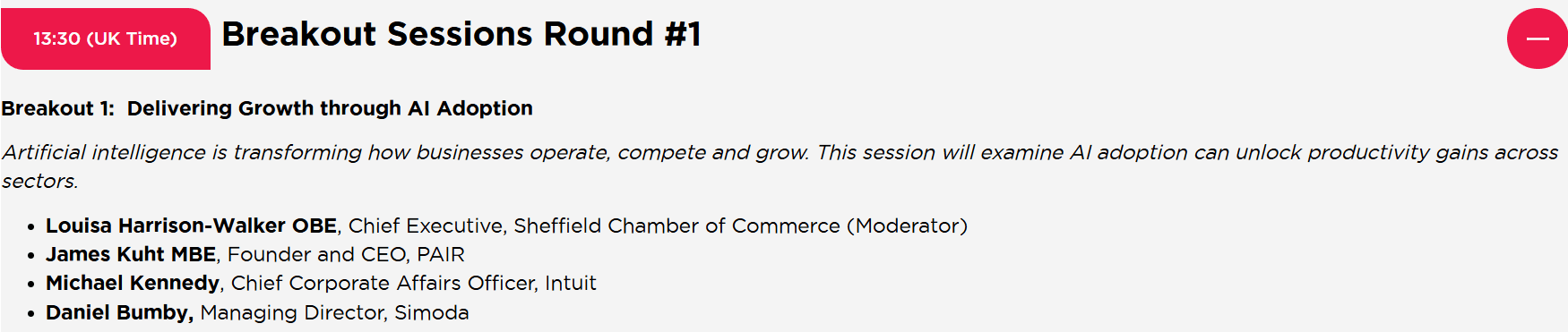
Want a deeper, more practical look at how SMEs are approaching AI right now?
Our whitepaper, “AI in the Trenches”, forms the foundation of the insights shared by Simoda’s Managing Director, Daniel Bumby, as he speaks at the British Chambers of Commerce Global Annual Conference in London, as part of the breakout session
If you’re ready to turn insight into action, speak to Simoda about AI and start your journey with an AI Readiness Assessment today.